Marketing · A two-part case study
File 01 / Marketing · University Project
Beyond the Game
From Consumer Insight to Creative Strategy
Understanding what makes people attend and what might bring them back.
MMK266 · Deakin University · 2026
Case study file
Brand contextAustralian Baseball League (ABL)
Part 01Assessment 1 · Interview Analysis
Part 02Assessment 2 Part A · Messaging Strategy Pitch
MethodsLaddering interviews · Means-end analysis · Hierarchical value map · Messaging strategy · Storyboarding
2 parts
About this project
This is a university project for MMK266 at Deakin University. It is not paid client work. The campaign in Part 02 is a proposal only: it was not commissioned, produced or run.
Part 01
Consumer Research & Insights
MMK266 Assessment 1 · Interview Analysis
01 · Research context
A growing market, a crowded field
The Australian Baseball League (ABL) is Australia’s top-tier baseball competition, currently fielding 4 teams Adelaide, Brisbane, Perth and Sydney across a November to February summer season, with plans to expand to a 6 teams format for the 2027–28 season (Australian Baseball League, 2026).
Australian professional sport is enjoying strong growth in revenue and engagement (Francis, 2025) but that growth is concentrated in sports with major broadcast deals: the AFL, NRL, cricket and tennis. To remain financially sustainable, the ABL must both retain its existing fan base and convert first time or occasional attendees into regulars (Australian Baseball League, 2026).
4
teams in the competition
Nov–Feb
summer season
5
sport codes competing for the same fans
02 · Research objective
Why We Went Looking for ‘Why’
Surface-level preferences (ticket price, location and the rest) only tell part of the story. Means-end analysis digs beneath these attributes to uncover the emotional and psychological payoffs and the personal values that actually drive attendance decisions. These insights will directly inform the messaging strategy the ABL needs to grow its fan base.
“To understand what live baseball attendance really means to Australian sport fans and why.”
03 · Research approach
Three levels of “why”
Uncovered through “laddering” interviews: a series of “why is that important to you?” questions (Reynolds & Gutman, 1988) with values grounded in Schwartz’s model of universal human values (Schwartz et al., 2012).
A
Attributes
Tangible or intangible features of the offering, e.g. ticket price, spectacle
C
Consequences
The outcomes: positive or negative that flow from an attribute, e.g. excitement, relaxation
V
Values
The underlying human needs those outcomes satisfy or conflict with, based on Schwartz’s universal value structure
From conversation to insight
01
Conduct laddering interviews
Three simulated ABL fan personas, each covering all 5 attributes
02
Code every statement
Labelled as an Attribute (A), Consequence (C) or Value (V)
03
Apply codes consistently
The same underlying idea gets the same code, however it’s worded
04
Build one combined map
Every perceived connection between codes plotted onto a single Hierarchical Value Map
Who We Spoke With
Participant #1
LocationParramatta, NSW
ProfileVeterinary scientist; migrated from Japan 5 years ago
Baseball familiarityAttended games in Japan, new to the ABL
Participant #2
LocationMagill, SA (Adelaide)
ProfileExisting Adelaide Giants fan, often attends with family
Baseball familiarityEstablished baseball fan
Participant #3
LocationYeronga, QLD (Brisbane)
ProfileDevoted cricket fan considering a first Bandits game
Baseball familiarityNew to baseball and the ABL
Method note
Based on 3 simulated laddering interviews (AI personas), not live fans: illustrative, not statistically generalisable. Participants are de-identified as Participant #1, #2 and #3 throughout, consistent with research reporting convention.
04 · Findings by attribute
Findings by Attribute
All three interviews covered the same 5 attributes: spectacle, game day experience, fan identity, stadium location and ticket price.
A1 · Spectacle
The universal hook
All three participants independently linked dramatic, high-energy plays to excitement: the single most consistently mentioned consequence in the entire study (C1: Excitement, n=3). For Participant #2, excitement fed a desire to keep coming back. Spectacle isn’t just enjoyable, it’s a reason to return.
“There’s nothing like seeing and hearing a player hit a home run right in front of you.”
Participant #2 · simulated persona
A2 · Game day experience
Three different payoffs
The same attribute satisfied three different psychological needs (light-hearted fun, community and stimulation), showing that “atmosphere” isn’t one universal mood but depends on what each fan is looking for.
“Those mascots and chants make me laugh and help me relax and have fun.”
Participant #1 · simulated persona
A3 · Fan identity
Belonging, choice and a real barrier
Fan identity produced the widest spread of outcomes in the study, from quiet belonging to an explicit cultural barrier, showing that “becoming a fan” depends heavily on what identity someone already holds.
“Baseball still feels a bit un-Australian to me, like a kind of silly American thing.”
Participant #3 · simulated persona
A4 · Stadium location
Convenience, safety and family time
Location mattered less for distance itself than for what it protected: stress-free travel, safety, immersion and energy preserved for the people participants cared about.
“I don’t want our fun night out to turn into a stressful or risky situation.”
Participant #1 · simulated persona
A5 · Ticket price
Value for money with a catch
Affordability wasn’t valued for the money saved so much as for what it freed participants from: guilt, financial stress and for one participant, doubt about whether the product was worth attending at all.
“Cheap tickets make me think the sport might not be that great to watch…”
Participant #3 · simulated persona
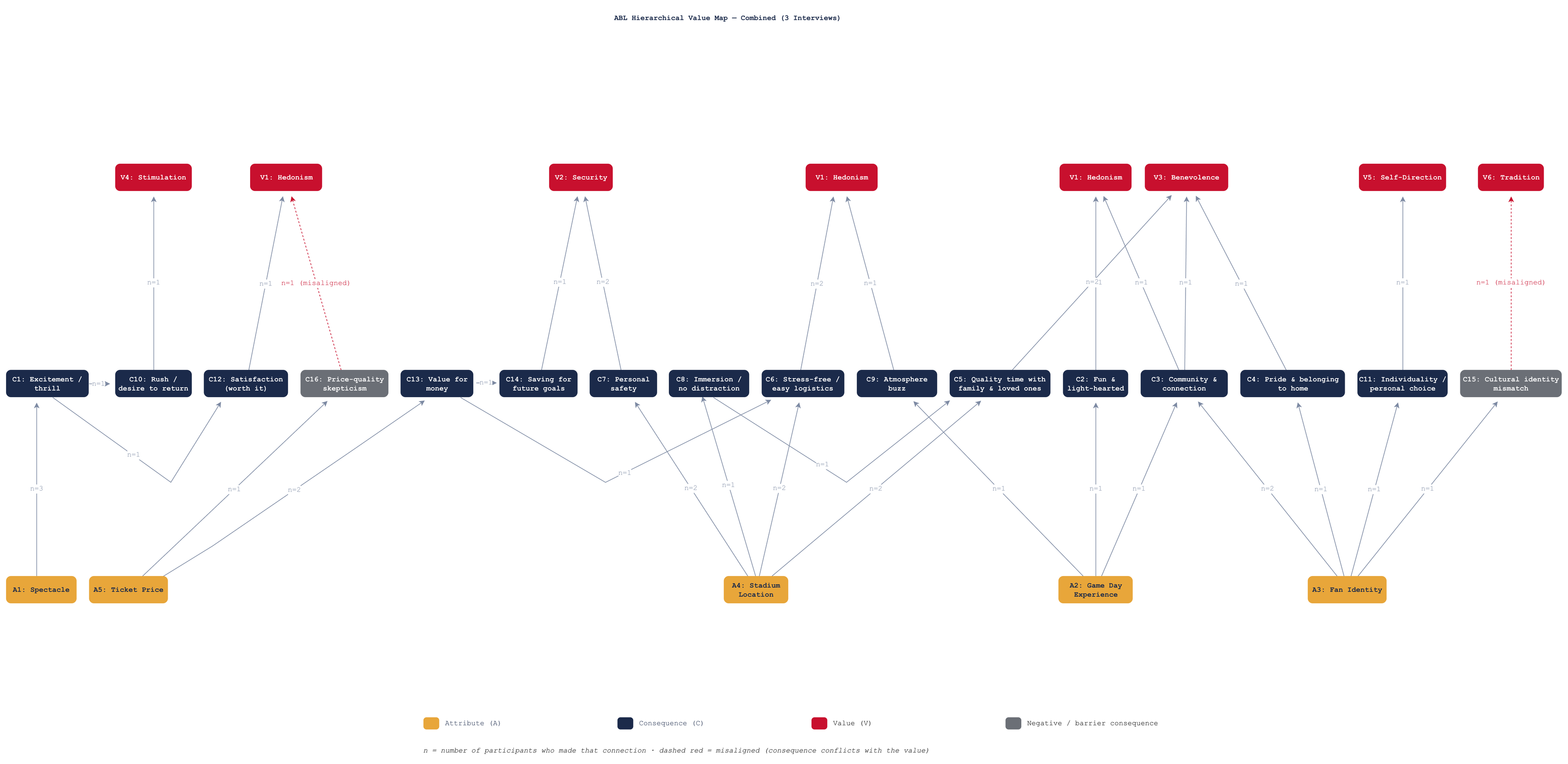
ABL Hierarchical Value Map: Combined (3 Interviews). n = number of participants who made that connection · dashed red = misaligned (consequence conflicts with the value). Tap the map to open it full size.
05 · Value level insights
What really matters and why
V1
Hedonism: fun is the common thread
Reached from more starting points than any other value: excitement, easy logistics, atmosphere and fan connection all ladder up here.
V2 · V3
Feeling safe, feeling connected
Practical reassurance (safety, affordability) and emotional warmth (community, family) both matter for different fans.
V4 · V5
Thrill-seekers and individualists
Some fans are drawn less by comfort and more by novelty and the chance to back something outside the mainstream.
Where the map pushes back
Two connections in the map work against attendance, not for it and both trace back to the same participant:
A3: Fan Identity → C15 ✖ V6: Tradition. His sense of national sporting pride is already satisfied by cricket: baseball offers no equivalent payoff.
A5: Ticket Price → C16 ✖ V1: Hedonism. Low price reads as a signal of a weak product: affordability quietly lowers his expectation of an enjoyable night out.
06 · Strategic implications
What the ABL Should Take Away
01
Lead with fun
Spectacle and atmosphere are the clearest, most consistent route to enjoyment across all three fans.
02
Speak to different payoffs
Game day experience needs to deliver relaxation, community and energy all at once, not a single mood.
03
Remove friction
Removing friction (safety, undistracted travel) doesn’t excite fans on its own, but for two participants, the energy and calm it preserved was ultimately spent on family connection (C5 → V3: Benevolence).
04
Sell belonging, not just baseball
Build local, home-grown credibility for the League itself, not just sell the in-game experience.
05
Watch the barriers
Traditional sport fans may need cultural credibility, not just excitement. And pricing too low can read as low quality.
Reading these findings with care
Based on 3 simulated laddering interviews (AI personas), not live fans. Limited to 3 profiles and the 5 attributes provided. One interviewer/coder introduces subjectivity. Findings reflect stated attitudes in an interview, not observed behaviour at an actual game. Future research: validate these value priorities with a larger, real fan sample.
From insight to strategy
The strongest shared A1 finding: all three participants linked spectacle with excitement/thrill (A1 → C1).
Part 02
Feel the Thrill Again
MMK266 Assessment 2 Part A · Messaging Strategy Pitch
01 · The challenge
A crowded field for fans’ attention
The ABL is Australia’s top-tier professional baseball league. During its November–February season, it competes for attention with larger, more established summer sports, including cricket, tennis, soccer, basketball and netball (ABL, 2026; Francis, 2025). To support financial sustainability and long-term growth, the ABL must maintain engagement among existing fans while building awareness and increasing live attendance among prospective and occasional attendees.
How do you encourage someone to return to an experience they once enjoyed, but have gradually forgotten?
Primary audience
Occasional attendees
Sport fans in Adelaide, Brisbane, Perth and Sydney who have attended an ABL game but do not attend regularly. They may retain a favourable association with the live experience that the campaign can reactivate.
Secondary audience
Open first-timers
Sport fans in the four ABL cities who have not attended an ABL game but are open to trying a new live-sport experience.
02 · The consumer insight
The Belief We’re Targeting
Attribute
A1 · Spectacle
→
Consequence
C1 · Excitement/thrill
n = 3/3
→
Value
V4 · Stimulation
n = 1/3
Evidence boundary: A1 → C1 appeared across all three interviews; only one participant extended the pathway to return intention and V4: Stimulation. Selection rationale: C1 is a consequence in the A1 map and appeared across all three interviews.
03 · Attitude strategy
Reinforce an existing positive belief
Rather than trying to change what audiences believe about the experience, I focused on reminding them why they enjoyed it in the first place.
Strategic alternatives assessed: C16 price-quality scepticism, fear appeal and evaluative conditioning. These options informed the strategy but do not appear as additional messaging techniques in the advertisement.
04 · Messaging techniques
How the Three Techniques Work Together
01
Narrative Advertising
Using a relatable story to reconnect audiences with memories and emotions.
The empty-seat mystery, the protagonist’s hesitation and the reunion create a clear narrative arc.
02
Social Norms
Showing how a personal invitation from a friend can make returning feel socially meaningful.
A personally relevant friend attends the game, saves a seat and sends an invitation.
03
Positive Message Framing
Focusing on the enjoyment audiences can gain by attending again.
Gain frame used: “Take your seat. Feel the thrill again.” Loss frame avoided: “Don’t miss another ABL night.”
05 · The creative concept
The Seat That Remembered You
Told through recurring views of an empty stadium seat. A friend saves it for an occasional attendee who nearly stays home. The final shot reveals the seat occupied as the two friends experience the game together.
As the crowd arrives and the atmosphere builds, a fan saves the seat for an absent friend. A message and a photograph from an earlier game invite him to return. After a moment of hesitation, he decides to go. The two friends reunite as the stadium comes alive.
0-12s
Empty-seat setup and seat saved
12-18s
Live atmosphere and memory
18-24s
Invitation, hesitation and decision
24-30s
Reunion and payoff
Admit one · Campaign tagline
“Take your seat. Feel the thrill again.”
The empty seat becomes a visual symbol of anticipation, friendship and the experiences waiting to be rediscovered.
06 · Storyboard
Ten frames, thirty seconds
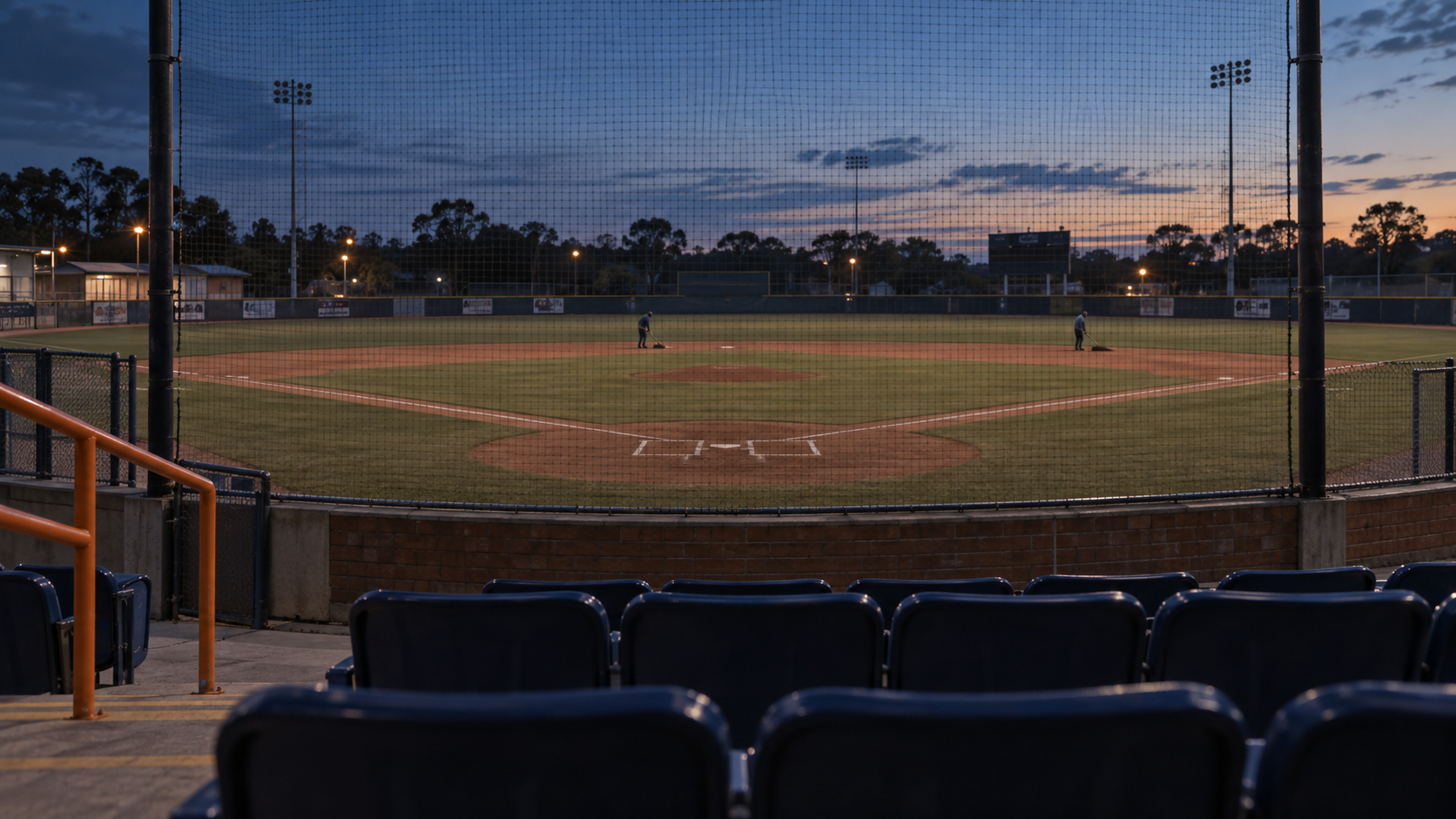
Frame 01 · 0-12s
A static POV from an empty stadium seat at dusk. Grounds staff prepare the field before spectators arrive.
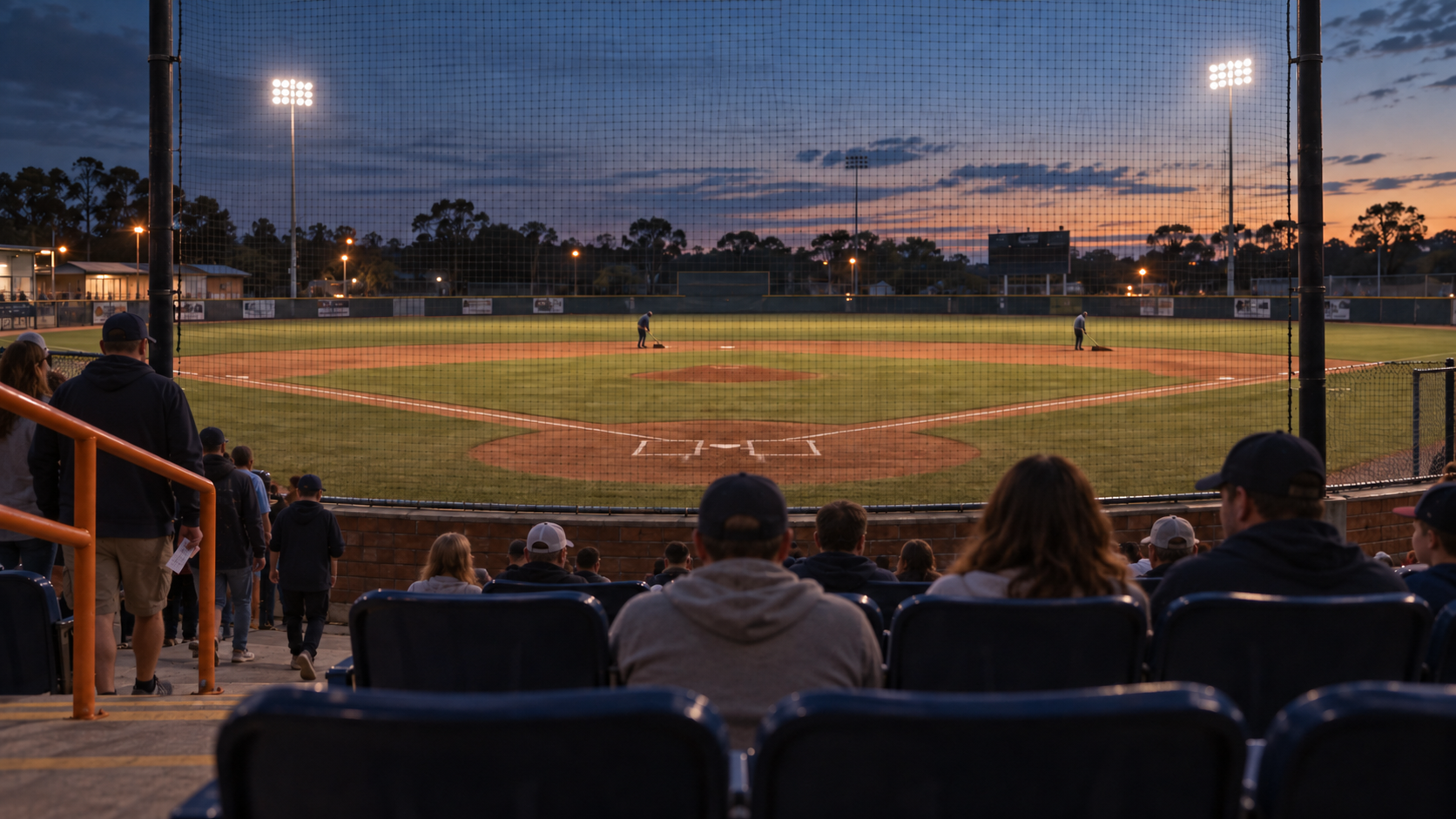
Frame 02 · 0-12s
From the same empty-seat POV, the floodlights brighten as spectators begin filling the stands.
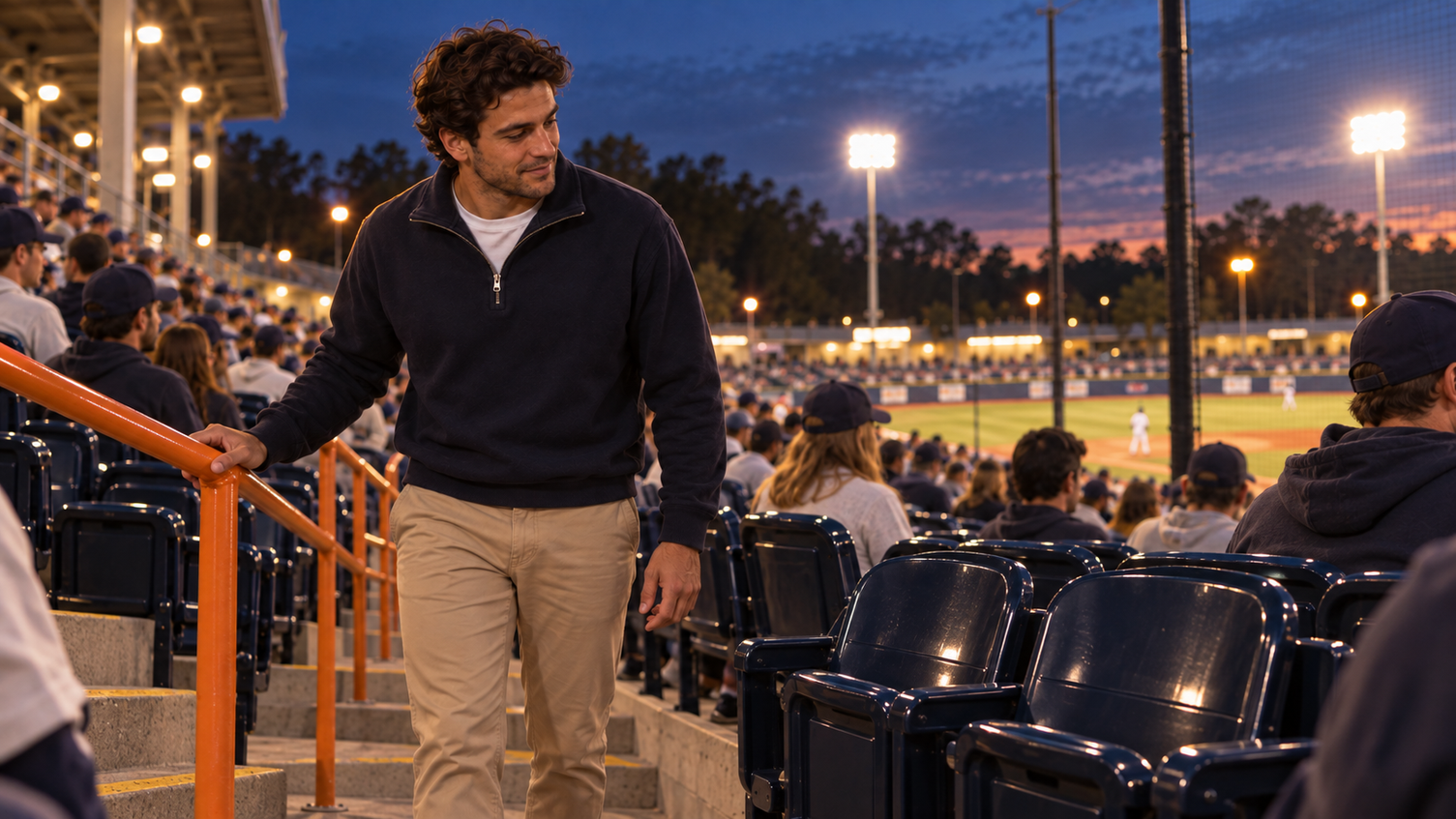
Frame 03 · 0-12s
The friend scans the row, spots two adjacent empty seats and moves towards them: one for himself and one for the friend he hopes will return.

Frame 04 · 0-12s
The friend sits down and drapes his navy jacket over the adjacent empty seat, deliberately saving it for someone who has not yet arrived.
Frame 05 · 12-18s
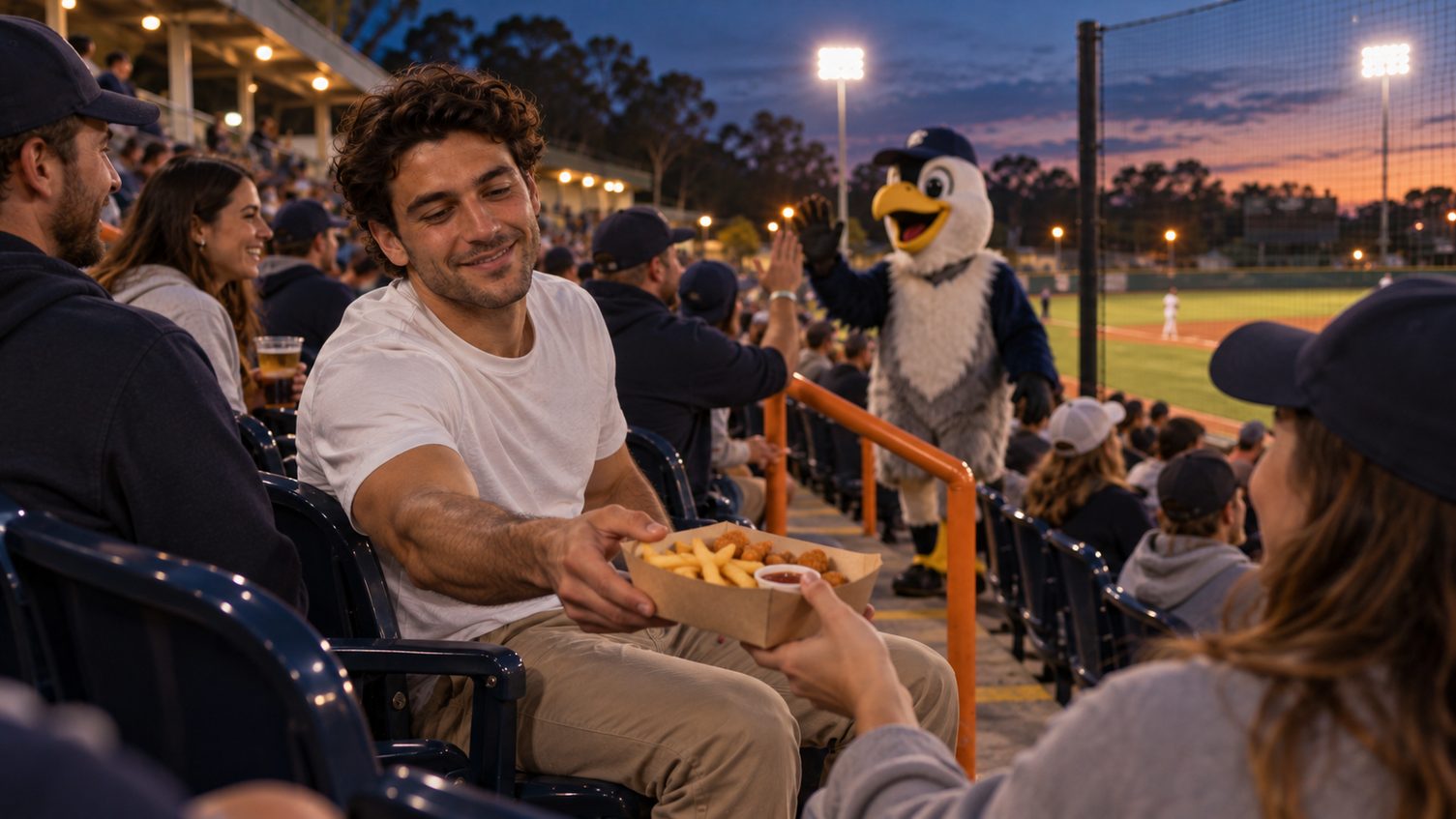
The stadium atmosphere builds around the still-empty seat. Fans pass food along the row while the mascot interacts with the crowd.

Frame 06 · 12-18s
The friend looks at an old photo of the two of them at the same stadium, then sends the photo and an invitation: “I’m here. Saved you a seat. Still coming?”

Frame 07 · 18-24s
At home, the occasional attendee receives the old photo and invitation, hesitating because returning means breaking his familiar routine.

Frame 08 · 18-24s
He reads the message again, reaches for his keys and leaves.
Frame 09 · 24-30s
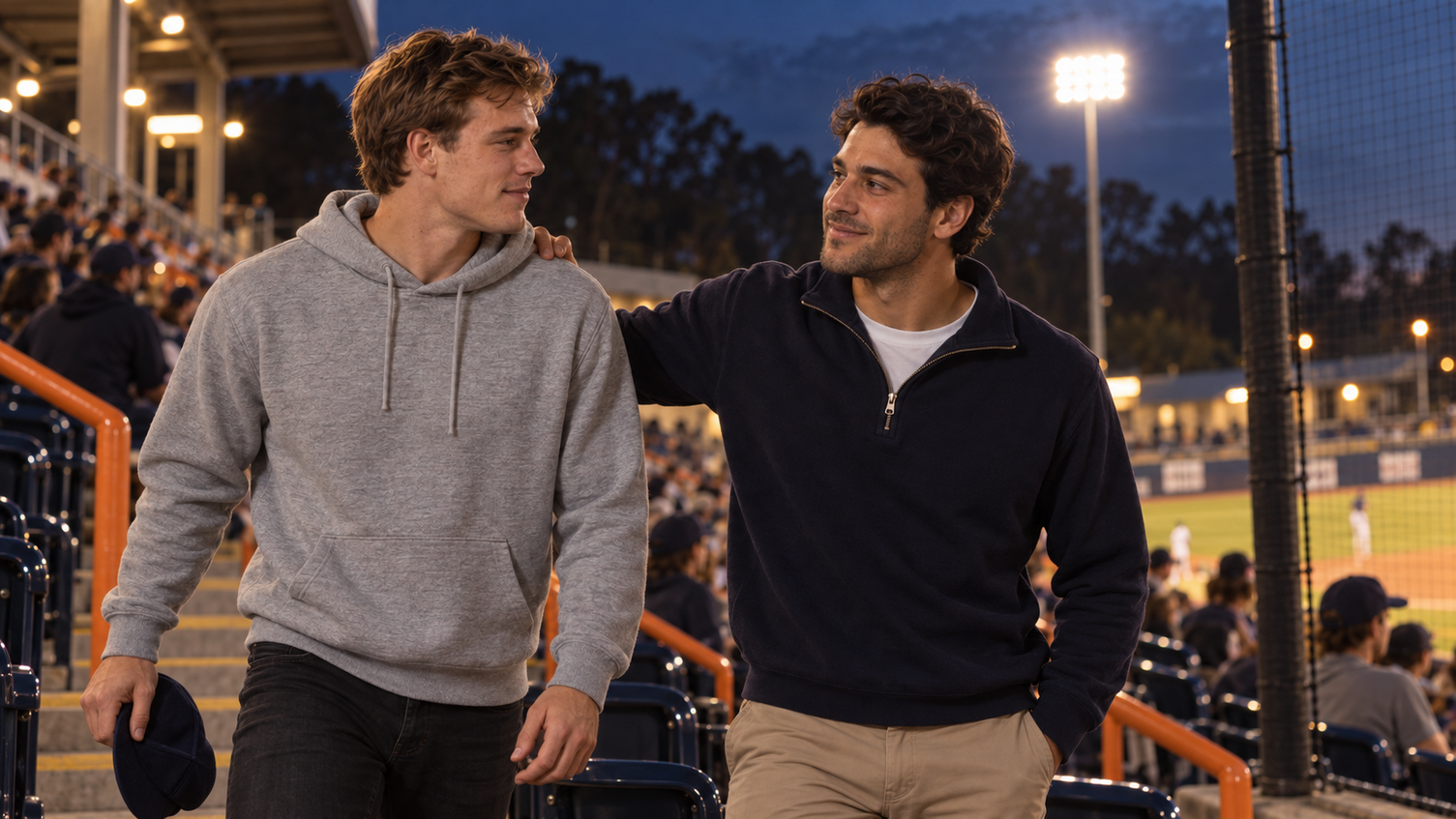
The friend meets him in the aisle, places a hand on his shoulder and guides him towards their seats. “You made it.”

Frame 10 · 24-30s
The two friends watch as the batter connects and the stadium erupts. The ABL logo, campaign tagline and ticket call-to-action fade onto the screen.
Storyboard visuals were created with generative AI as part of an academic advertising concept.
AI acknowledgement
I acknowledge the use of ChatGPT by OpenAI (accessed September 2026) to generate storyboard images from my prompts and to provide feedback on the grammar, clarity and presentation of my messaging strategy. My prompts specified the characters, stadium setting, shot composition, narrative purpose and visual continuity required for each storyboard frame.
07 · Beyond the advertisement
The Pre-game Confidence Pack
An email sent after ticket purchase to reinforce the excitement of attending, provide practical game-day information and help reduce uncertainty.
Confirm the choice
“You’re in.” Congratulate the buyer and reinforce the benefit they selected: the excitement and thrill of attending ABL live.
Make the visit easy
Provide transport, venue entry, seating and ticket-access details, plus a concise “Baseball in 60 Seconds” guide.
Reassure with social proof
Include one verified fan quote and a short authentic game highlight. This reassures buyers without implying that every game will produce an identical experience.
This extended the strategy beyond attracting audiences to supporting their experience after purchase.
08 · Key learning & reflection
What I learned
This project showed me how consumer insights can guide creative decisions.
Rather than selecting advertising techniques simply because they are engaging, I learned to connect each technique to a specific audience belief and strategic objective.
It also challenged me to think about how storytelling, social influence and message framing can work together within one coherent idea.
Knowing the limits
Based on 3 simulated laddering interviews (AI personas), not live fans: illustrative, not statistically generalisable.
Gain-frame effects are small and context-dependent, so this choice rests on its fit with C1 rather than assumed superiority (O’Keefe & Jensen, 2007).
Mao and Oppewal studied university choice rather than live sport; its application to ABL ticket buyers is theoretically grounded but not directly tested.
Note
The final deliverable was a proposed campaign strategy and storyboard, not a live advertisement. Its effectiveness would need to be tested with real audiences.
Good creative work does more than attract attention. It gives people a reason to care.

